The same goes for the sculptures [the Schwarm series] – on its own a toothpick doesn’t have much effect – but once you pass the couple thousands mark you reach a level of visual quality that wasn’t there before. It has to do with human pattern recognition, we’re just wired to see patterns in everything. So as soon as we have so many of these single items which seem to be moving together, a shift occurs and they become an entity.
Do you often start with a pattern from nature?
No, although it might look similar to nature – the artworks [in the ] are more about the final composition than the original motif – it’s about the process of the abstraction but not what is being abstracted, not the original images the composition is based on.

Instead of working off particular motifs or patterns, I usually work off of a couple lines of code and keep trying out things until it feels right. Most things come about through persistence, waiting on inspiration or thinking a lot conceptually can slow you down, in the end you need to keep working at it until something comes through. This isn’t to say the coding involved is really complex, that’s also not of importance to me. It’s about the end result and not what is behind it.
“Most things come about through persistence, waiting on inspiration or thinking a lot conceptually can slow you down, in the end you need to keep working at it until something comes through.”
Does your work ever have a more conceptual edge?
Yes, there are projects where I’ve done months of researching, such as back in 2007, a project I did focusing on the ongoing economic crisis. I had to read-up on macroeconomics in order to get a good grip on what was happening in the grand scheme of things. It helped me find an interesting angle in order to create the artworks.
So I spoke to an economist who explained to me how the global GDP (or the economic output of the whole world) compared to the world output in leaves this huge bubble of paper or value on paper, with no backing like gold or goods, nothing. Pure inflated speculation.
Out of this I made two sculptures that fit together: one mold showing the world GDP, and one that fit on top, showing the derivatives – illustrating this “bubble”.
But then again, most conceptual work requires too much time to be done on a constant basis, so these last few years I’ve been more focused on developing my aesthetic style and experimenting.
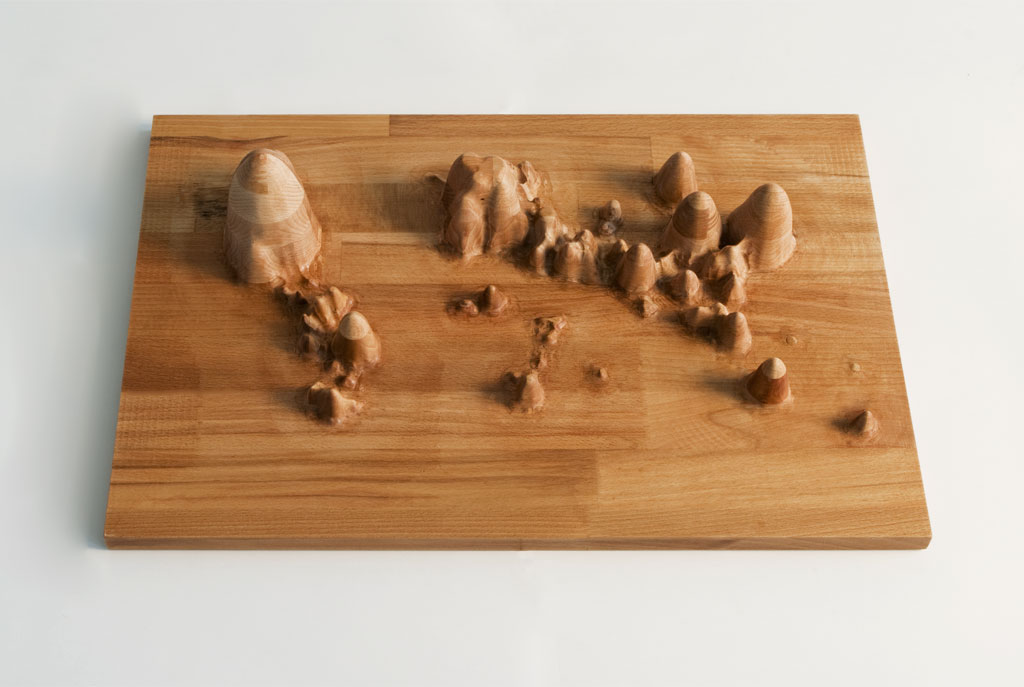
Mapping of the world gross domestic product 2007
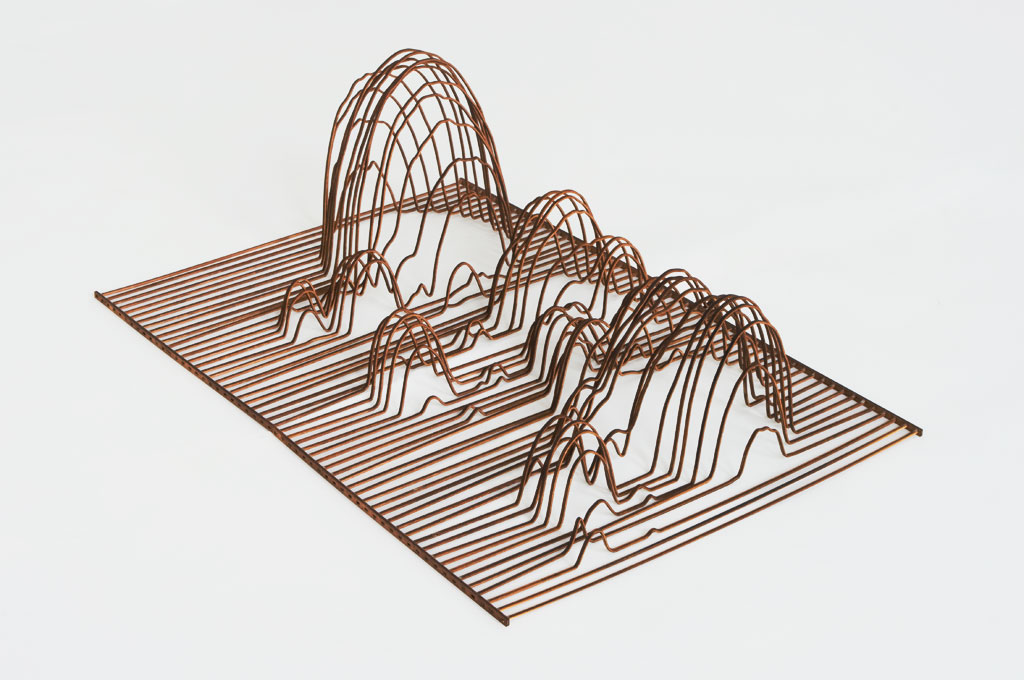
Mapping of the world derivatives volume 2007
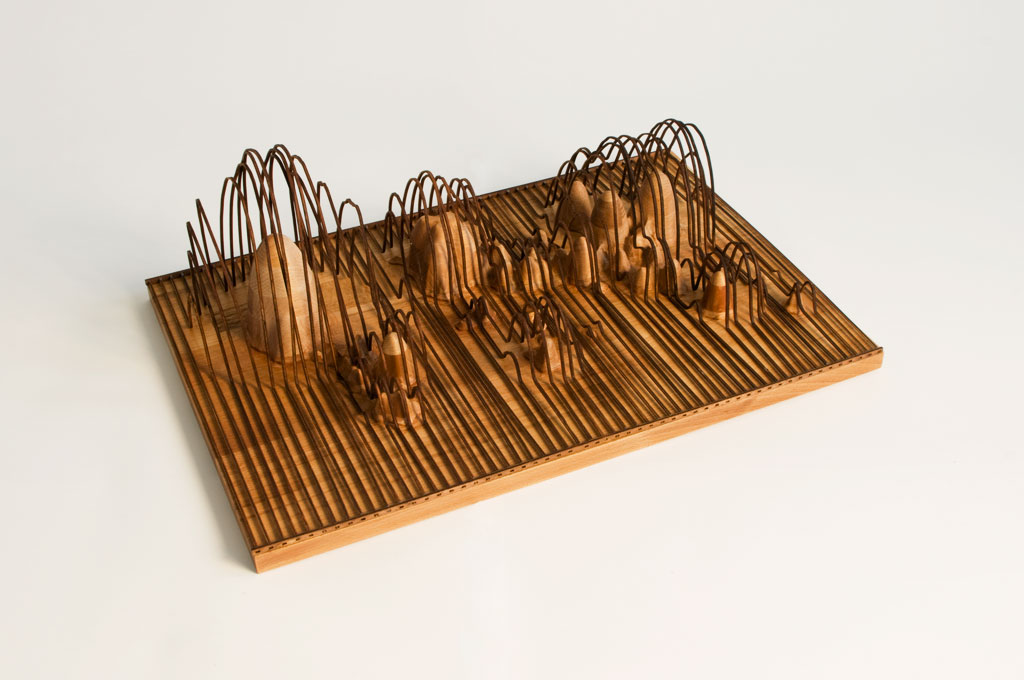
Fundament – Andreas Fischer 2008
Data, Beech wood, poplar plywood; 40 × 60 × 20 cm;
A lot of your work balances between still and motion, and some is both. Do you visualize or create things with still or motion in mind?
I don’t really think in terms of motion and still – I build systems that can be animated or rendered into print just as easily. A lot of times it happens when I working on the project, such as a video in which a still really pleases me – I’ll just use that separately.
Have you ever worked with more traditional media?
I did a lot of drawing, but nowadays I mostly do sketching – forming ideas and writing.
Collaborations?
I frequently collaborate for commissions. But apart from that I also work within the artist collective . Occasionally we get together and do commercial work or workshops.
Directed by – 2011
Do you pull inspiration from web-based resources or more outside?
I have huge catalogue of images, and spend quite some time on platforms like FFFFound or Tumblr. But sometimes I won’t use that for ages. The problem sometimes with this sort of image overload is that you’ll get an idea, which you think is yours, and later on realize you’d seen it before on the net. It kind of puts things in an awkward position. But then again, sitting in front of a blank page and pulling everything from nowhere doesn’t really work for me either.
Well the image-overload is something I’m constantly looking through, and I find it to be fascinating how after a while you begin to see things in a more general perspective: you begin noticing things that are different and original in contrast to the copies of copies. Tumblr, for example, is particular in the way images are filtered.
Yeah, just don’t call it curating.
Exactly.
And having good taste isn’t enough. You need to make and produce things, not just take stuff from one website and put it on another. Then again, I always feel like an old man while saying these things – if Tumblr was around when I was 16, of course I would have had a Tumblr, probably several of them. But in the end what counts is you ability to produce something of your own out of this assemblage of images. All that time spent re-blogging, maybe it isn’t lost, but it isn’t going to really get you anywhere either.
“But in the end what counts is you ability to produce something out of this assemblage of images. All that time spent re-blogging, maybe it isn’t lost, but it isn’t going to really get you anywhere either.”



